The Whitney Biennial Should Admit That Emilie Gossiaux Wants to Fuck Their Dog
content warnings: human and anthro nudity, discussion of bestiality, modern art
Credit where it's due: it is genuinely, unironically baller for the Whitney museum to make the exhibit about how a disabled artist wants to fuck their dog the first one that people see when they attend the prestigious Whitney Biennial, their every-two-year showcase of new and emerging American talents. You know, the one that's supposed to be a barometer of where America is at these days.
Unfortunately, not only do they fail to commit to the bit, the critics then also fail at their own job. Like, here is how one art critic at ArtReview describes it:
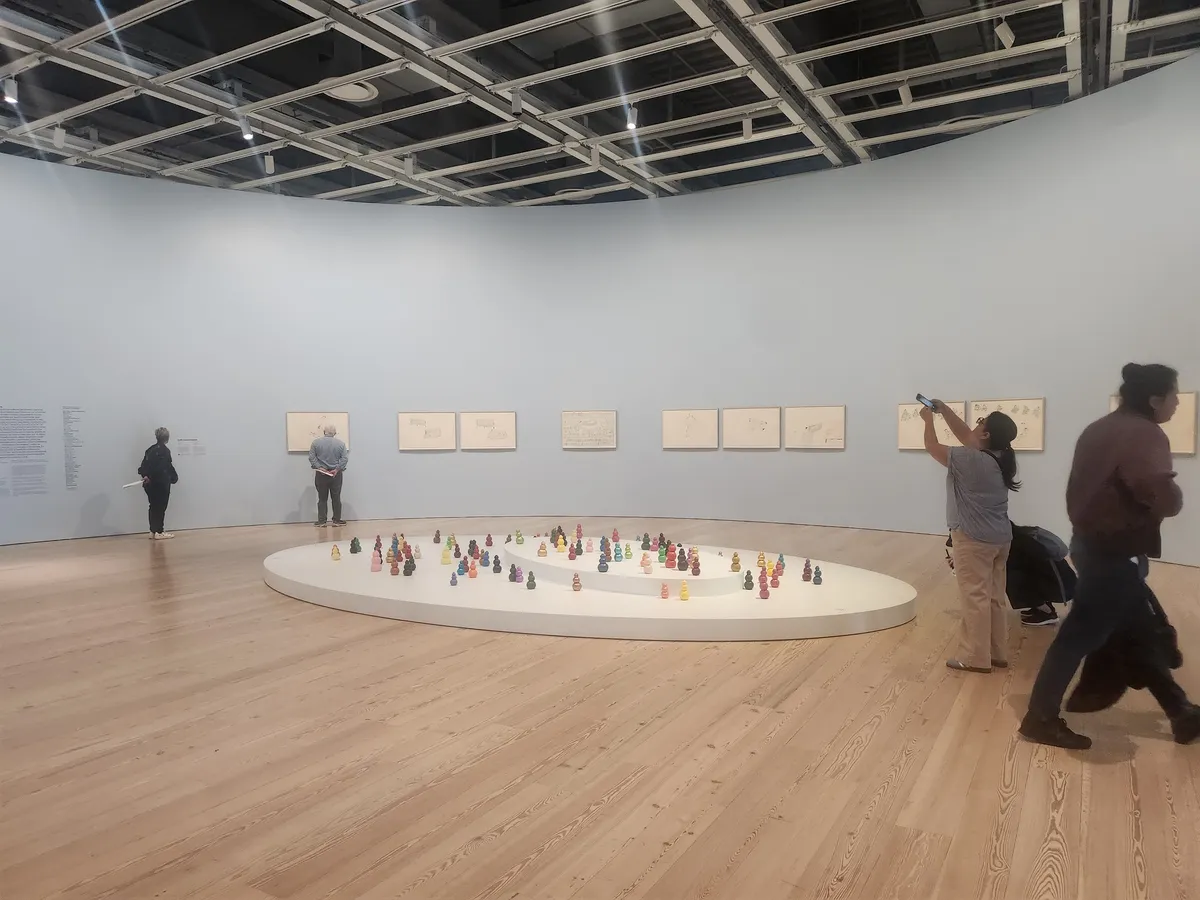
Visitors first encounter Emilie Louise Gossiaux’s Kong Play (2025) – a hundred or so small, brightly coloured snowman-shaped ceramics arranged on a low two-tiered pedestal. These sculptures are modelled after Kong chew toys, a tribute to the artist’s guide dog (Gossiaux lost their vision in a bicycle accident in 2012). Accompanying Kong Play are variously titled ballpoint pen and crayon drawings by Gossiaux that depict the artist playing with a jaunty, sometimes bipedal, white canine. The exhibition thus opens tenderly – without fanfare, without friction.
And another, from artnet:
Emilie Louise Gossiaux’s tribute to their deceased seeing-eye dog opens the show on the fifth floor, a suite of winsome drawings of the artist with their pooch, plus a landscape of ceramic dog toys meant to evoke “doggy heaven” for their lost helper... As an opening gambit for the biennial, it signals a “sincerity first” credo, as William Van Meter wrote yesterday; art that promises a vicarious sense of emotional connection over impressive form—the look of conceptual art, but with concepts swapped out for feelings.1
Here's one more, from a 4Columns reporter who proclaims this installation to be one of their favourites from the entire 50-person show:
It’s an installation of drawings and sculptures by Emilie Louise Gossiaux, made in memory of (and, as they say, in collaboration with) their guide dog, London, who died last September. On a pedestal on the floor are one hundred ceramic replicas of London’s favorite chew toy. Surrounding this are eleven smallish framed drawings depicting person and dog snuggling, cavorting, their bodies commingling. The drawings are naïve in style, their lines incidental, and they poignantly capture the soul connection between a human and the canine who makes their life possible. 1
And here's the little placard that the Whitney has by the exhibit, if you're just going in blind without having already read a bunch of reviews:
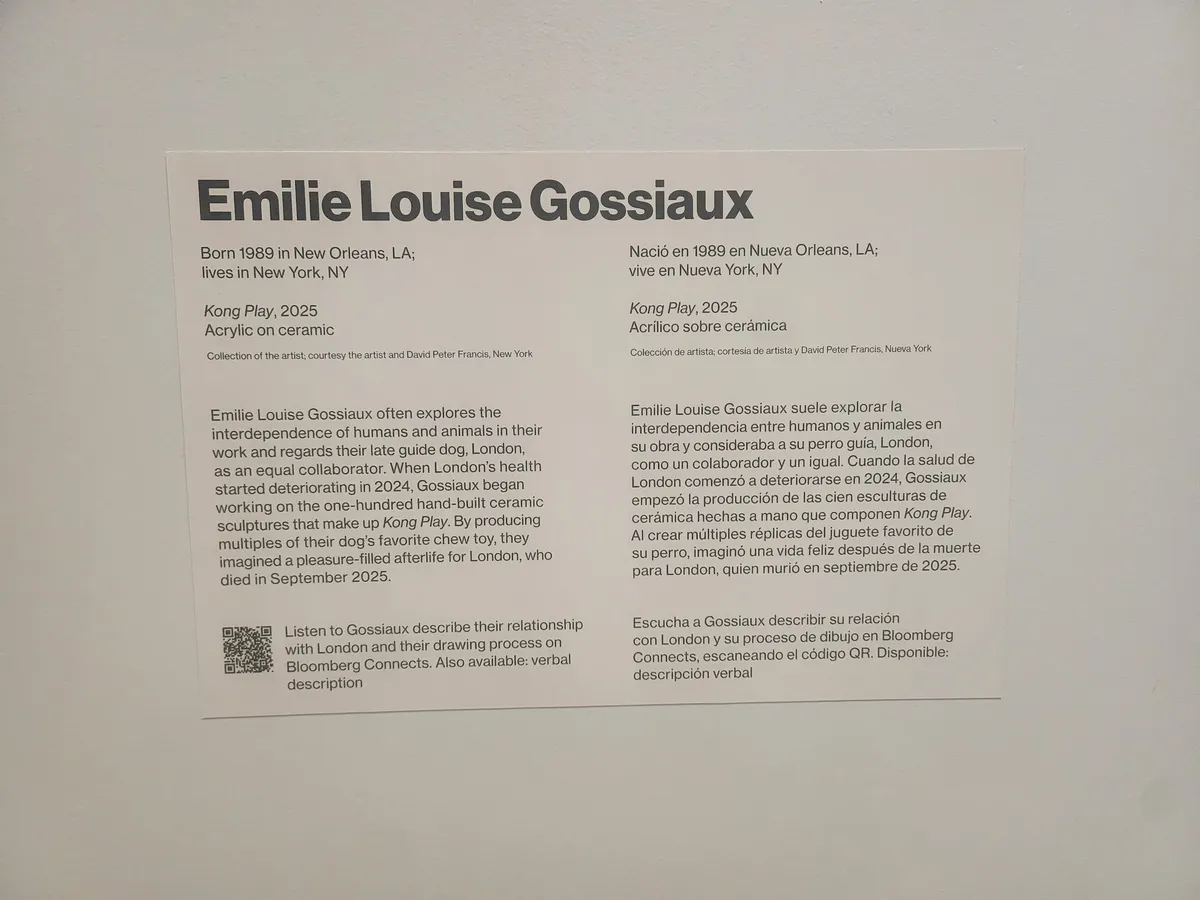 Placard Text: Emilie Louise Gossiaux often explores the interdependence of humans and animals in their work and regards their late guide dog, London, as an equal collaborator. When London's health started deteriorating in 2024, Gossiaux began working on the one-hundred hand-built ceramic sculptures that make up Kong Play. By producing multiples of their dog's favorite chew toy, they imagined a pleasure-filled afterlife for London, who died in September 2025.
So everyone's saying the same thing: It's a blind person's tender and sincere tribute to London, their beloved, recently passed guide dog.
From this, you really don't get the sense that Emilie Gossiaux wants to fuck their dog.
Gossiaux's Recent Body of Work
Let's take a step back and look at what Gossiaux is trying to say with their body of work, which for the last five years has been focused on their relationship with London, their dog. Their own words about the Biennial exhibit (emphasis mine):
London, to me, was more than just my guide dog. I thought of her as my mother or my child. So it was very cyclical. And sometimes it can take a couple of years for a guide dog and their human to feel like they are in a marriage together, that is kind of like an arranged marriage that your trainer sets up for you, and you have to work with that and build on that, until it starts to feel like you're in a true partnership—like a spouse.
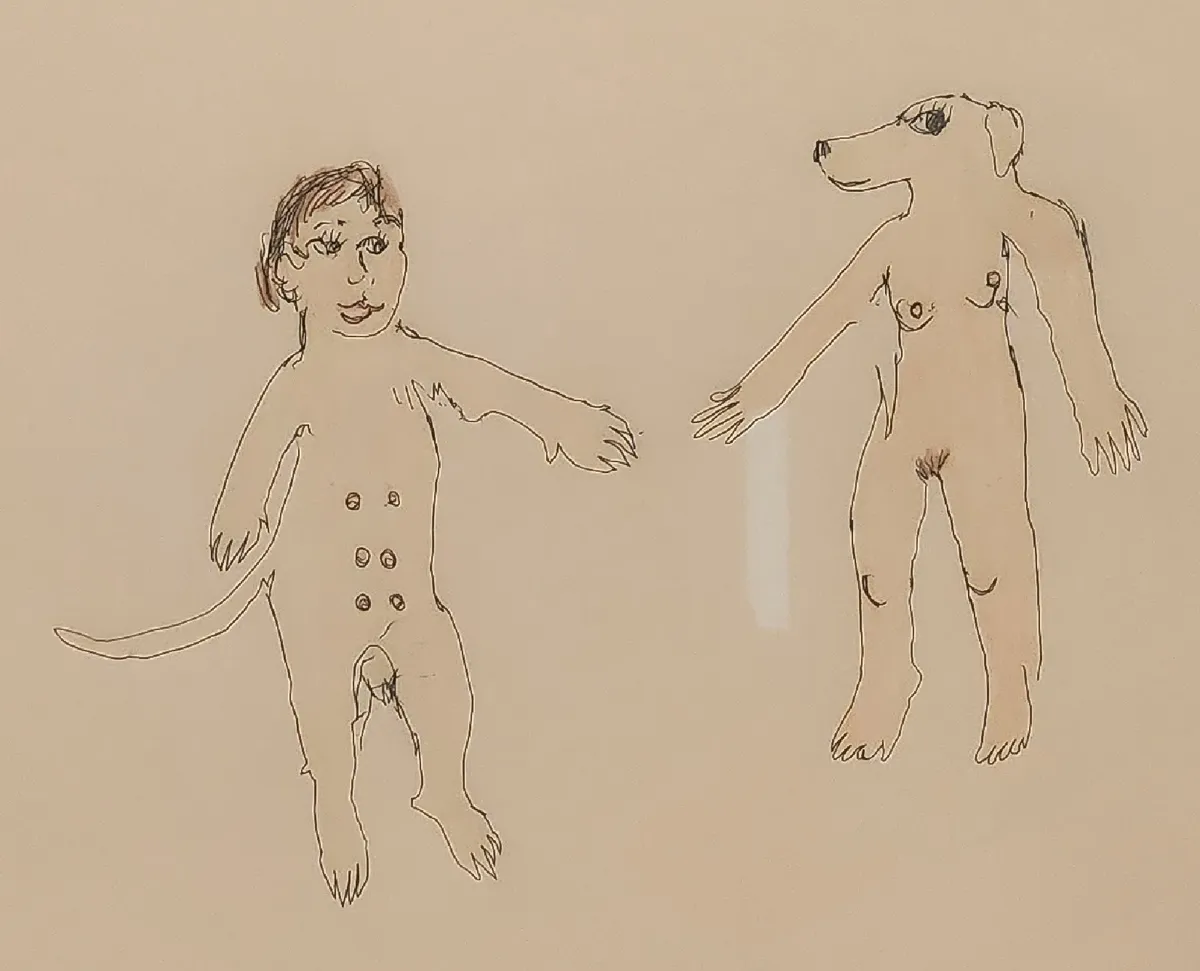 "The Marriage of Hand and Paw", 2025 (detail). Gossiaux is blind and draws using a rubber pad beneath the page to feel the lines by touch.
In an interview with cultured mag, they elaborate:
The drawings that I was making towards the end of London’s life were exploring the afterlife, and also about what it was like to care for London. The weight of it and the sadness of it. Saying goodbye to such an important person and reflecting on the connection we have. She came into my life and completely changed it for the better.
They also talk about the texture of that relationship, how they navigate it and feel it as a blind person:
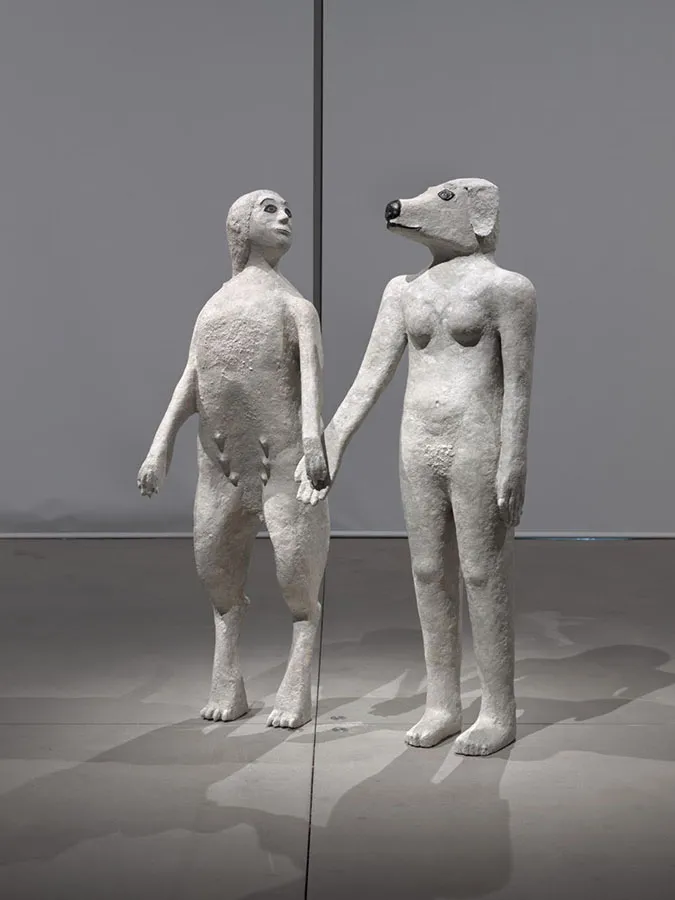
The way I experience the world, I see with my two hands. Touching London is kind of fragmented. My hand is on her tongue, and my other hand is on her ear. So I have that physical memory of the size and the shape of London’s head and her ears and her tongue and her face. That’s my reality. The more fantastical, whole sculptures are like the world that I want to live in.
"fantastical, whole sculptures" likely refer to works like "True Love will Find You in the End" (2021):
In another interview from 2025, they elaborate on the experience of being codependent with a guide animal:
All my work for the past five years has been about this profound connection that I have with London, my guide dog and animal companion, who is an English Labrador retriever. I got London in 2013. She has been retired as my guide dog for the past three years. We've been together for over a decade, so this feels like the longest relationship I've had with another being. ... It's a relationship that isn't like any other between an animal and a human, I think. It's stronger than a pet. Really, it's kind of radical to think about putting so much dependency on an animal, who is also 100% dependent on you. I describe it as an interdependent relationship, which means that we're mutually dependent on each other. To put that much care into someone, and for them to put their life on the line for me—it's just a beautiful thing. It's really powerful. ... Some of my other recent work includes a character I created called Doggirl, which is a hybrid animal: me and my body hybridized with a dog's body—more specifically with London. It’s how I see myself and how I imagine the outside world sees me, as a girl who's dependent on a dog. But I feel like, with London and me, the way we are both dependent on each other really just makes us stronger together when we're whole or when we're working and collaborating together.
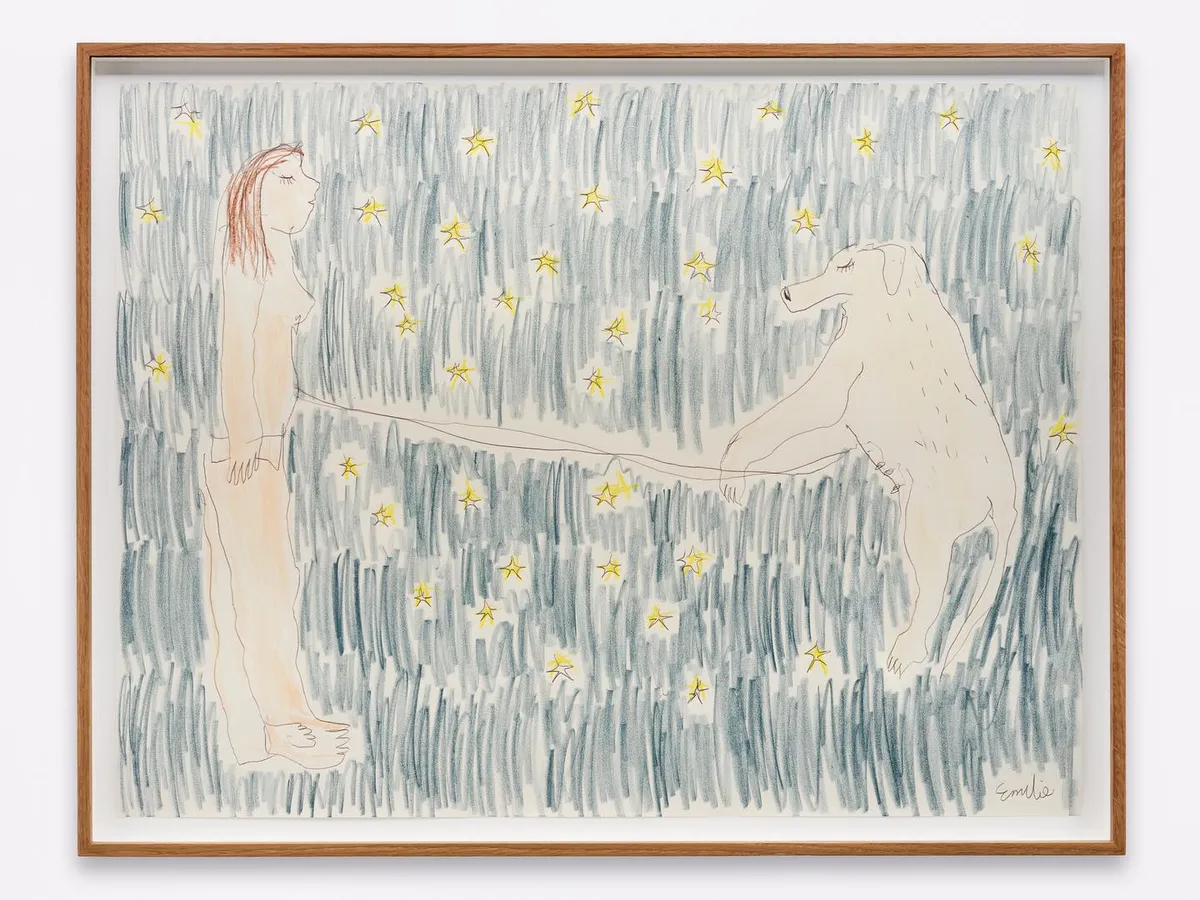 "Dogs and Humans Figure a Universe", (2022).
Here's the accompanying Gallery Text for that one, which is also quite illuminating: Against a scrim of stars, girl and dog— a specific girl, a specific dog—face one another. Both are bipedal: upright, unattired, similarly scaled, eyes serenely shut. A line unfurls across the middle of the composition to link them belly-to-belly. A leash, an umbilical cord, a sacred ligature: as the particularities of the tie are left open-ended, the fact of the connection—its centrality, its undeniability—feels like a cosmic event.
Take a minute to really put yourself in Gossiaux's shoes. As an art student in your early twenties, you were hit by an 18-wheel truck and lost your sense of sight. London, a guide dog, enters your life in 2013. Do you remember what you were doing in 2013? (I was partway through high school, which seems like several lifetimes away now.) You cannot navigate the world without London, and she cannot survive without you. You experience the world with her help, with your sense of touch - and the being you experience the most frequently is London; her soft velvety ears under your hand, her body nudging and pulling at you to guide you where you need to go, the warmth and texture of her tongue when she licks you.
Sometimes, after a long day out, you would put music on when you get home. She would put her paws in your hands and you would dance to celebrate the day being done, the rough pads of her paws on your palm. It is your favourite part of the day.
In such an enmeshed relationship, it doesn't take you long to realize that London has agency and emotions and preferences, not unlike you. You try to respect them as much as you can, and you really think of your relationship as a partnership, with an equality that other people perhaps have a hard time wrapping their heads around. Perhaps you're frustrated by how most people don't seem to think of other animals as capable of having personhood, like you know London to have. Her personhood is so obvious to you.
By 2022 (what were you doing in 2022?), she's semi-retired; the commute to your studio is too long for her to manage with her reduced mobility. You've known her for ten years at this point; she's taken care of you for ten years. You love her so much, and in the coming years you spend your days tending to her in her old age.
When she dies after twelve years with you, in September 2025 (what were you doing eight months ago?), the grief is oceanic. No one understands the nature of the love that you have with each other. You put it in ways that others will understand: you say that it's like losing a mother, a daughter, and a spouse, all in one. But it's not really like that, it's another kind of relationship entirely, another kind of love. A love with no name. And there is some part of that love feels unspeakable.
Because when humans (and dogs - we are all mammals after all) love, they love with their bodies, and they love the bodies of others. You are no different. You love London, who you see as an equal and as someone with personhood, and she loves you back. You try to express this love in ways that she understands.
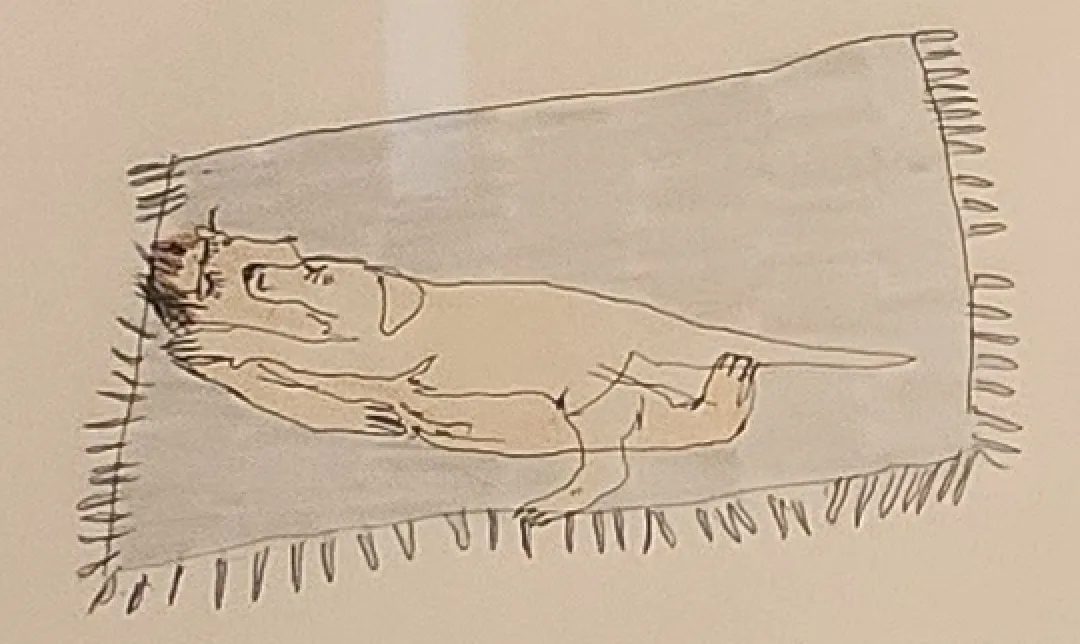 "Surrendering to You", 2025 (detail).
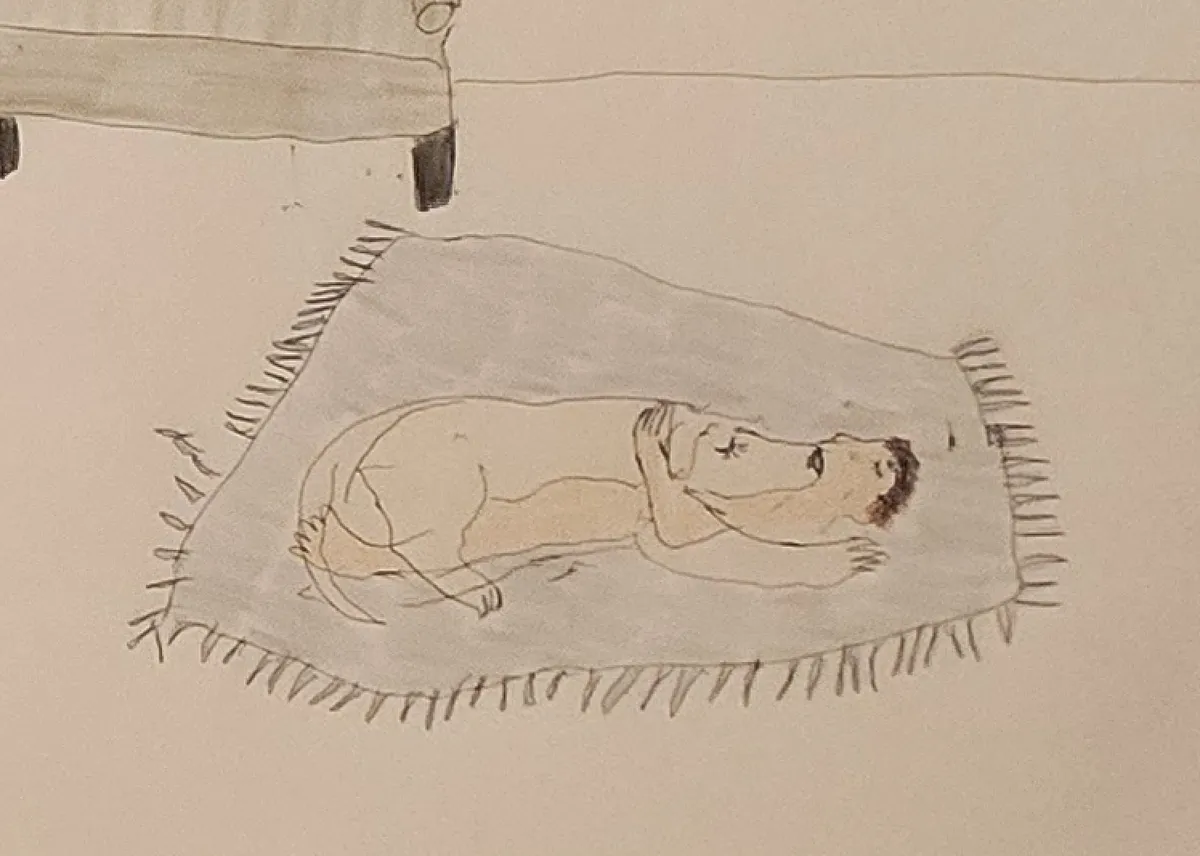 "And You Alone", 2025 (detail).
But your own understanding, your own culture, maybe that's important too?
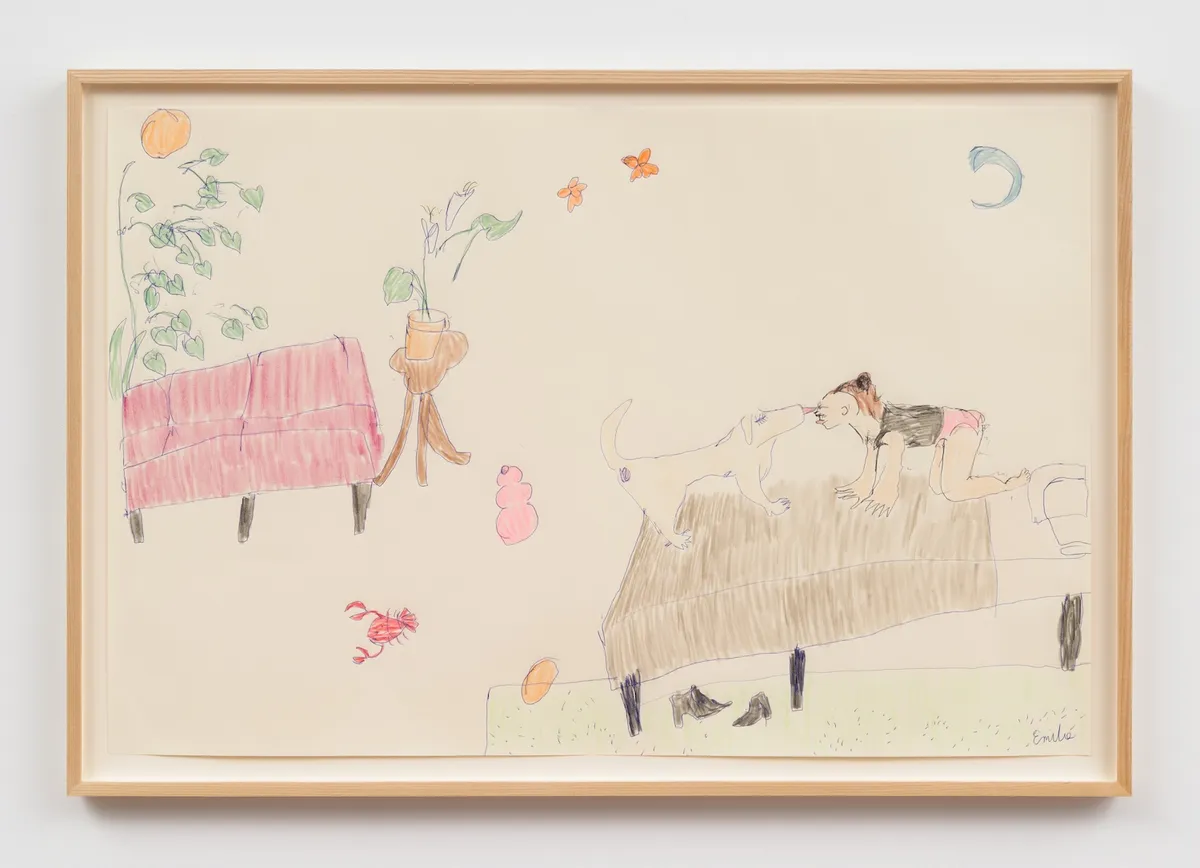 "Playing in Bed (with lobster)", 2025. Artist website image alt text: On the bed, Emilie with brown hair in a bun, wearing a black tank top and pink underwear, is on all fours, facing London, a blonde English Labrador Retriever. Their faces are close together with their tongues affectionately licking each other, as if French kissing. London is drawn with a long tail.
Let Art Be Challenging
Gossiaux hasn't been particularly secretive about the sexual undertones of their works with/about London. About a previous installation they literally said that they wanted to create a "wet dream" and "pleasure palace" for her. And to an observation about how the sculptures of the Kong dog toys seem vaguely sex-toy like, Gossiaux comments:
I enjoy that ambiguity. It’s like, Why is this making me feel weird and also making me feel really happy? I have a drawing where one London is mounting another London, and they’re trying to reach with their tongues to lick Kongs that are levitating in front of them. It’s playful, sexually charged, with a double meaning. Are they playing, or are they doing more?
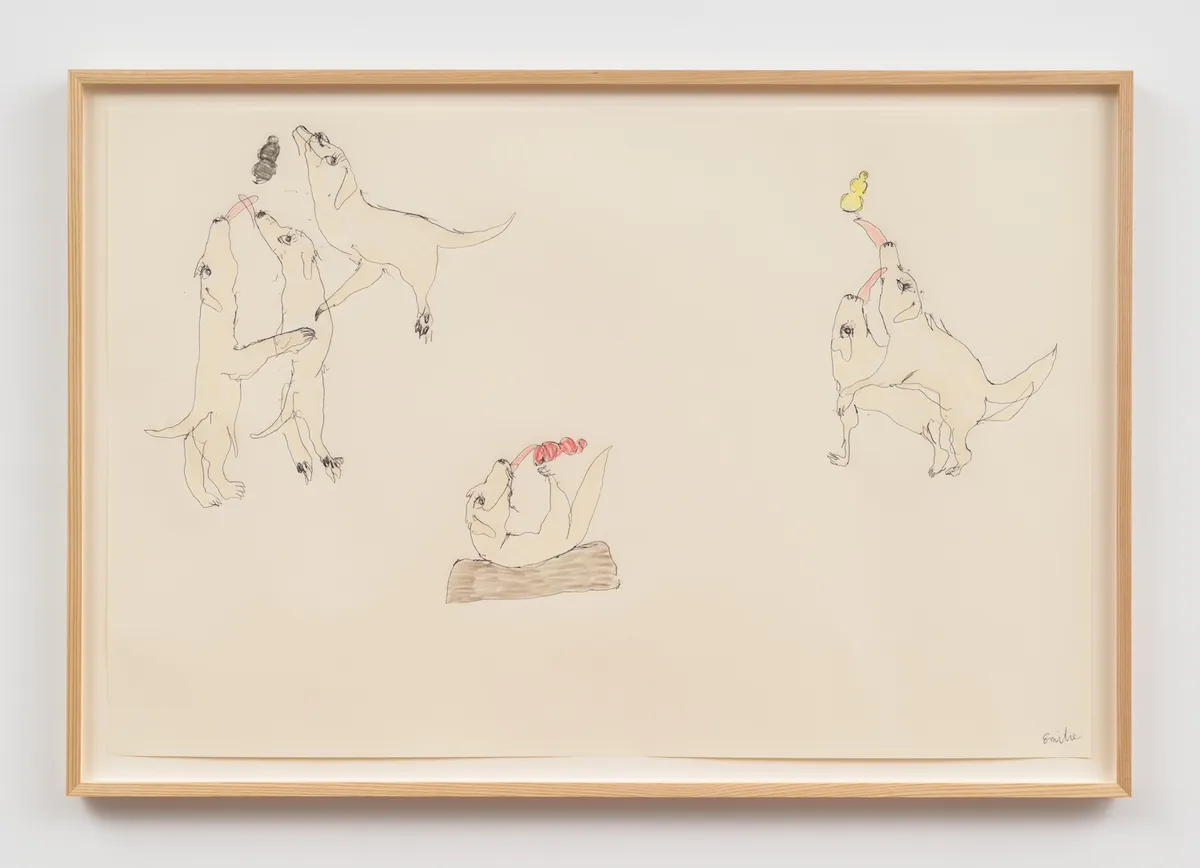 “Kong Play, One Two Three”, 2025.
So it's really not like Gossiaux is pussyfooting around here. They title their works things like "Playing in Bed", "Surrendering to You", "The Marriage of Hand and Paw", and even "Menage a Trois" (which features their human partner as well). They drew pictures of themselves kissing the dog with tongue, more than once, and described the depiction as "French kissing". They had a solo exhibit titled "Significant Otherness" back in 2022, which was also about London. They said with their whole chest directly into the microphone that they "enjoy the ambiguity" and deliberately drew London in "sexually charged" poses. What did you think spousal relationships meant? Vibes???
I want to make this clear: it is incredibly based for a disabled artist to create art about their intense, codependent, ambiguously sexual relationship with their support animal who shared their daily life and body more than most humans ever will.2 This is a level of consent discourse that humanity as a whole will not be ready for for another three hundred generations of internet discourse, and they're just going ahead and cracking that nut wide open. I adore this. Having thought about this work, about this sort of relationship, having now learned about Donna Haraway's work exploring relational encounters between human and nonhuman species ("Significant Otherness" is a direct reference to Haraway's work), my head is now full of new questions that I've never considered before:
- What are other kinds of relationships humans can have with animals, besides farming them, keeping them as pets, or passively observing them?
- How common were these other kinds of relationships throughout history?
- Should we be granting dogs more personhood? What does that look like? How does pet ownership change if pet owners understand their pets to have personhood?
- How do different animals experience their sexuality? How similar is it to how humans experience theirs?
- How do specific animals experience their sexuality? Each person has a different experience to their own sexuality; should we expect the same to be true for dogs? For all mammals? For all animals?
- What was London's sexuality like?
- Can animals ever consent to having sex with other animals who are not their exact species? How far apart do they need to be on the evolutionary tree before it gets sketchy?
- Can animals ever consent to having sex with humans? How confident are you in your answer? How would you know, for sure?
- What do we mean and what are we ultimately solving for, when we invoke the concept of consent? What human-centric assumptions are bound up in our cultural conception of consent?
Rather than meet their energy, I think the Whitney acted incredibly poorly in sanitizing this transgressive exhibit to all hell. And I think the art critics who reviewed the Biennial (and there's so so many reviews) acted poorly in either playing along, or being wilfully blind to what is in front of them. It's unfair to the artist, and it's also unfair to the gallery goers, so really what are we even doing here.3
Because when I first saw Gossiaux's works, the vibes were so off. I had no idea how to orient around it. I knew there was something not right about it, this sexuality seething right under the surface and not being engaged with at all. It's very uncharacteristic for modern art museums and the commentariat to not engage with the sexual themes or undertones with works on display, they're not exactly prudish institutions!
And look, I will be the first one to cop to not really being an Art Knower at all. My art history is more holes than not, my home city's modern art scene is trash, and this is literally the first art show I've been to in my life that was prestigious enough that there is coverage and discourse about it.
If someone wants to claim that I'm very poorly suited to write this piece, or there's something fundamental here that I don't get, they'd be completely right! But for some reason4 there's this curious institutional silence around this very fascinating question being interrogated at the Whitney Biennial, and yours truly unfortunately feels entitled to begin/join all discussions of all subjects, so here we are.
Excerpt is lightly edited to correct the misgendering of Gossiaux, who uses they/them pronouns.↩
Hilariously, when I first asked Claude about this exhibit's sexual undertones Claude gaslit me too by saying that it was so incredibly problematic for me to think that this disabled artist's work about their dead support dog had any sexual charge to it and was cold to me for the rest of the chat. I had to start a new window and give my woke credentials!↩
Especially when the director of the museum cites free admission programs as examples of his political work, presumably with the intent to provide more opportunities for those who are less enmeshed in the art scene to engage with interesting contemporary works!↩
Why might that institutional silence exist? Claude and I came up with a list of plausible reasons. One, since wokeness ate the world it became sort of impossible to talk about disabled artists in sexualized ways. Originally this was a somewhat useful corrective since there's a long history of sexualizing and objectifying disabled bodies, but this has since ossified in unfortunate ways and we're now unable to engage with the sexualities of disabled people at all. I'm kind of reminded of Aristotle's idea of the virtues being moderation between two vices (e.g. bravery = perfect medium between cowardice and foolhardiness) here: if you swing too far away from sexualizing disabled people, you end up unpersonning them in a different way! Still, going on record as the critic (or the curator!) who said "this disabled artist wants to fuck their dog" is a career move with, shall we say, asymmetric downside. Two, it's harder to talk about when it's about a specific artist and a specific recently-dead service animal. There's a comfortable academic register we can use to discuss, like, cross-species relationality, but it's harder to do so when discussing the alive person Emilie and their dog London who died eight months ago. Three, legal liability. There's a slight but nonzero chance that I will receive a takedown notice on this blog post accusing me of defamation, because I am, incidentally through my interrogation of their exhibit, suggesting that Gossiaux is committing what is in fact a crime in many jurisdictions. (Promoting sexual contact with non-human animals seems to count as bestiality in some states; no actual sexual encounter needs to actually happen.) Four, the Biennial's only been out for a few months and I'm doing the equivalent of despairing that there's not even a thousand works of Heated Rivalry fanfiction on AO3 two days after the premiere.↩