Brown Fields, Mausoleums
[Previously: Green Fields, New Games]
The opposite of greenfield development is brownfield development. Brownfield development refers to work that happens with historical constraints. It looks like building a shed/yurt/standalone suite in the backyard, or adding three storeys to a structure that was already there, or tearing down that structure and then building something else entirely on the plot of land.
We are wired to prefer green over brown. This is reasonable; brownfield development is a pain in the ass. One time I was involved in redeveloping a brownfield plot. We thought we'd be okay for soil testing, since the plot was only ever zoned for light commercial (meaning you can't even, like, have a restaurant or a laundromat there), but when we did the soil tests we got a nasty surprise. It turns out that seventy years ago in a plot across the street, there used to be a gas station, and so there's just bits of gasoline in the ground all around for a block or so. We had to remediate the soil before we could do anything else, and this added 6 months to our development timeline and 20% to our costs.
By the way, brownfield development is the only way you can make cities dense and compact and efficient, instead of creating ever more suburban sprawl.
I have played in green fields, and I understand the appeal. I have personally urged people to contribute to the sprawl, when the hassle of doing brownfield development would stop them from otherwise building anything at all, and I think this is correct.
The only reason to ever engage in brownfield development is if you value something more than you are intimidated by the ghosts. Eventually I reached the edges of the green fields of my online intellectual home, and I yearned for more, and so I started reading old books.
And I found early on in my journey that the man who invented the essay also invented 80% of the discourse norms that I treasured in my community, the ones that we expended effort to build up from ~first principles over two decades. Five hundred years ago, Montaigne urged us to have epistemic humility, to thank the person that proves us wrong instead of hating them, and to bet on our beliefs. (More on Montaigne here.)
What a waste of time, eh? Imagine if we had all read Montaigne in school instead, and everyone afterwards too, and when we found each other it was to start building the third floor, rather than the foundation. (Though perhaps I am saying this on the fifth floor, and lamenting not being on the eighth. It's somewhat a matter of perspective.)
Brownfield work is often required to produce things that matter, things that will stand the test of time. New York City is brownfield development over brownfield development over brownfield development. So is Wikipedia, and cancer research, and bending our civilization and our civil law codes towards justice.
As you build, the difficulty increases. It is much harder to build the fiftieth storey on a ramshackle structure than it is to build the second or the fourteenth. And I wonder: did we abandon the great books, the great conversation, because the weight got too heavy? I see this gleaming thing that we were gently extricating from the dirt over centuries, Hobbes to Rousseau to Freud to Foucault all in one single holy tradition of what we would call today the classical liberal arts, trying to figure out the meaning of it all, of selfhood and civilization and how we can do it all better. Worse, I feel like we got... so achingly close to figuring it out by the end? And some would say what happened at that moment was that the tower collapsed under its own weight, its contradictions, its complicity with injustice. But I wonder if another framing is that it just got too complex to hold inside a single human skull, or even a distribution of them.
Judith Butler's Gender Trouble (1990) was still engaging in The Conversation, but Who's Afraid of Gender (2024) meets readers on green, green turf. What happened? Perhaps the added complexity of the last thirty five years couldn't even fit inside the skull of Judith Butler. Perhaps everyone else who was actually conversant had aged out of the game, and out of readership. Perhaps both of these things happened, and some other things too.
I'm partially writing this essay (and the previous one) because I came across this supposed syllabus for surviving the 21st century. It is made by some people in the tribe I am in. It refers almost exclusively to the writings of my tribe, and the books that we like to read, plus some internet racists added in for spice1.
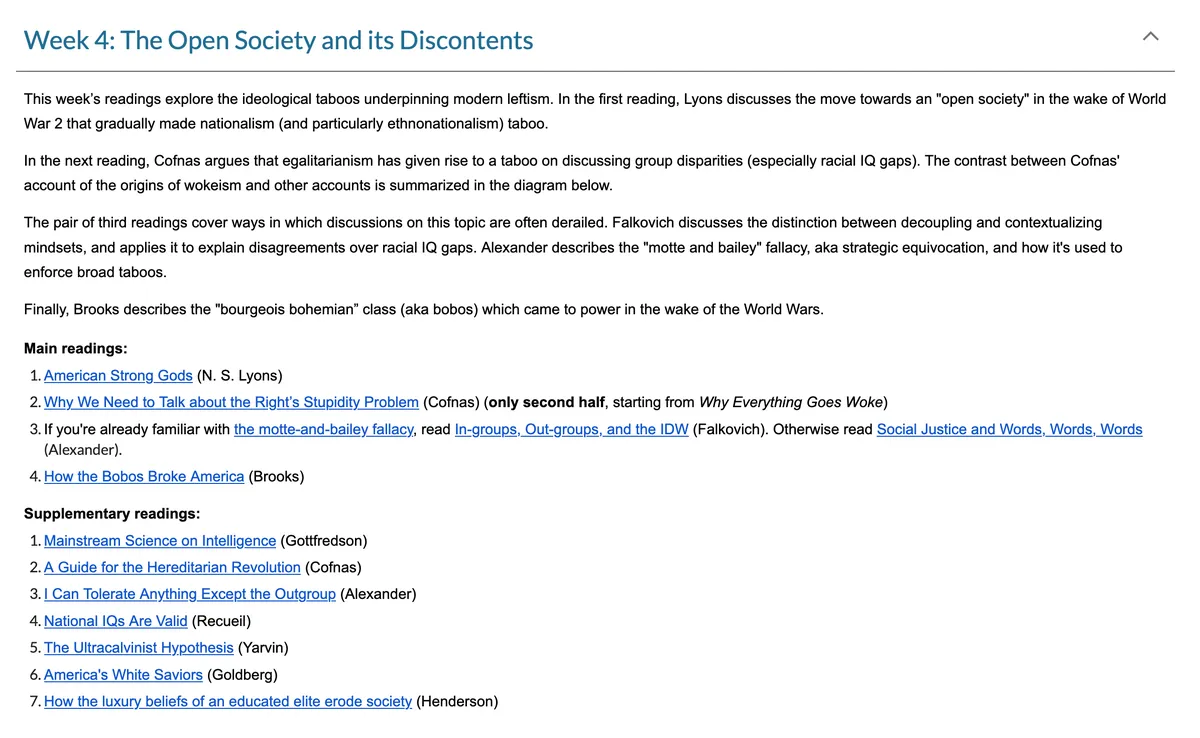 title referencing freud but hes not even an optional reading smh
But to rail against this seems approximately as productive as railing against the fact that, like, humans get thirsty and must drink water2. People prefer green over brown, at least in my corner of the world. Perhaps this preference is an evolutionary quirk that benefitted us in an ancestral environment, and because of this constraint some number of our species must get to work re-interpreting the wheel for every new generation. Perhaps it's not so different from the way that some number of our species must be occupied with growing our food, and teaching our young, and we'll need to keep doing it season after season (though hopefully one day soon it can be done by benevolent robots). And I am part of a contingent who don't mind it as much, being in the mausoleum, the way I am part of the small contingent who prefers my left hand over my right, and so I go there sometimes of my own free will.
I do wish that people who are going into the mausoleum are not called white supremacists and imperialism apologists so much. Yes, there's contamination in the soil, that's why brownfield development often requires remediation. But the contamination simply means you have to do the work more carefully. Besides, the alternative is more sprawl, forever, and that's homophobic because I can't drive.
There are not a lot of people suited to this work, and I wish there were, in much the same way that I wish most humans were better at decision theory, or coordination, or not hurting each other so much.
I often don't like the other people I bump into inside the mausoleum; sometimes they say things like "we need to ban contraception for the sake of the species" and "actually we should have more religion instead of less". I do not consider these people to be well suited to mausoleum work, even if they spend an awful lot of time in there.
Others have an approach that I think is a little more subtly flawed; they know much about the radiation and contamination in the soil, and so they flinch away from the good and the bad things both. They try not to take anything except the smallest and most obscure pieces, and are defensive about taking anything at all.
I shouldn't complain too much. I too am a member of my species, so I am also not suited to this work; I only tolerate the darkness and the cobwebs because in the mausoleum are things that I like. Sometimes, for weeks on end, I do not enter, because I am more absorbed by the things on the surface, and it's cold and confusing and misogynistic as hell in there.
I go into the mausoleum, when I can stand to, and when I wish. I excavate what I can. I bring back what seems valuable. Some other people are yelling about other parts of the mausoleum that are more important to go into for the sake of civilization not breaking down. But I am intimidated by all the technical stuff in that section so I only hang out in my own little section anyways, pleasing myself. And when people build in the green fields, I try not to think about it in terms of opportunity cost. I try to be understanding of the limitations of my species, me included, and extend a little grace.
--—
It is unsurprising to me that a syllabus compiled by Burja and Ngo looks like this, and I am actually fuming mad about the laundering of racism here, but I don't want to go into it in this particular essay. Cards on the table I do think that this detracts from my point somewhat, turning it away from "greenfield suboptimal" to a more generic "people I dislike bad", but I do think my critique would still apply to even the best version of a ~rationalist community reading list for dealing with the 21st century.↩
Pre-registering with love that I am expecting as many as several of you to pop into my dms to be like 🤓☝️erm I am against this too ackshually↩