Contra Contra Rich Friend, Poor Friend
Since I published Rich Friend, Poor Friend, it's been discussed on the Slate Star Codex subreddit, on a podcast episode, by my new friend Lucie on her own Substack, and then by me yesterday in I Became the Rich Friend.
Lucie's discussion in "Contra Rich Friend, Poor Friend" intersects with my musings in I Became the Rich Friend in interesting ways, so I would like to offer a response here. If I am understanding her correctly, she is making the following points:
- You can choose to interpret request for help as demands, or to interpret them as mutually beneficial instead
- When you help your friends, this often enables them to help you in turn
- Being a person that is excited about helping others enables you to make many good friends, having slack enables you to help others more, so having more resources allows one to make friends more easily.
Interpreting Requests for Help
In Rich Friend, Poor Friend, I write:
If I get a message from someone who wants to visit town and crash in my spare bedroom, but I'm not close enough to them that hosting them would be intrinsically valuable to me, and I know they're making enough money to afford an airbnb, I think it's rude if they ask. [emphasis added]
Lucie writes:
Bob operates by the rule: “If you are sufficiently poor and desperate and have no alternative, then I will give you lodging and support. If you are not sufficiently desperate, you don’t deserve my help.”
and:
What if, instead of seeing those requests as demands of Bob to self-sacrifice, he saw those as offers that may be taken if they are mutually beneficial?
My friends are the people I love interacting with. When they ask if they can stay over at my place, I receive it as an offer that I can take if I’m excited about it.
I think this is a misunderstanding of my original point. I am already doing all of the mutually beneficial trades!
Bob (Jenn) actually operates by the rule: If my friend asks me for a favour and it seems mutually beneficial, I take them up on the offer gladly. If I am not enthusiastic, I ask for a cheerful price1. If they are actually in need and have no alternative, I will provide lodging and support and tank the cost.
I think Lucie does not actually disagree with this strategy, especially as she says:
I don’t have anything against a bit of utilitarianism, and I’m sometimes doing such trades myself when someone is in a much worse position than me.
Alright, moving on to more productive disagreements.
Helping Your Friends Helps You
Lucie writes:
My friends are the people I love interacting with. When they ask if they can stay over at my place, I receive it as an offer that I can take if I’m excited about it. And usually, I am excited about having them stay over! I get to spend more time with them, I get helping hands for my projects and managing my house, I get someone to talk about what I’m currently thinking, and I get an occasion to go on adventures. When they want me to listen while they talk about something that’s bothering them, I get to learn more about them, I learn to be a better friend, I learn more about what it is like to be other people, and I get perspective into my own life.
Sometimes, people I’ve never heard about ask if they can stay over. That’s exciting! I’ll learn even more! And they do tend to become my friends by the end of their stay.
Sometimes, when you are doing your friends favours, you get something out of it in return. I agree that this happens, and it's really wonderful when you can engage in mutually beneficial trade. But if this happens the majority of the time, I think that is an indication that you are gatekeeping what labour you are willing to do, for example by asking "how much this person is fun to be around" and "is this stranger part of the same extended scenes I am in (and thus likely to be fun/shiny)". I don't think there's anything precisely bad with gatekeeping labour this way, but I also doubt that it's superior from the way I do things.
I agree that there is some amount of mindset change that you can likely do on the margin. For example, if your friend asks you to be an emergency babysitter, you can psych yourself up to be more enthusiastic about interacting with tiny humans even if you are not particularly into doing childcare.
I don't think this is a thing you can do consistently, especially if your friends are asking you for more acute things like a five thousand dollar bailout or for you to put them up for a few months while they try to get back on their feet after getting laid off. Having someone sleep on your couch for a week can be fun! Having someone sleep on your couch for four months is going to be a sacrifice. It can be a sacrifice you take on gladly and consider worth it because you love your friend, but it is very likely not going to be positive sum for both of you.
So, I agree that you can get your friendships to deepen by continuing to engage in mutually beneficial trades, but I think that only goes so far.
Recall that my original thesis is not around all friendships, but that it's much harder for financially comfortable people to make deep friendships, which I ~define as "people you can trust to have your back when shit really hits the fan".
You really don't need to go that deep in friendships before you are in the realm of plausibly doing things that will not actually be pleasant. Some examples of what I think one should do for good friends:
- help them process their recent breakup by listening to them talk about the exact same thing the fifth time this week, and actively trying to do so with fresh ears even though you've heard it all before
- consistently deliver food to them for days or weeks if they are sick or grieving, when they are not at all going to be good company
- badger them regularly to do stuff that is good for them to do, like going for a walk or feeding themselves, even when it is annoying for you, and you know it also annoys them in the moment that you are doing this
- gently and repeatedly invite them to talk about deeply unpleasant things that are no fun to talk about for either of you, such as how they feel about a close family member passing away, or a horrible relationship they can't leave, or a chronic illness, or some part of themself that they are struggling with coming to terms with
- disrupt your work and all of your plans to go keep them company during a rough time in their life, possibly at significant economic cost (plane tickets, meals, etc)
- help them fix up their resume and apply for jobs online, even though filling out online job applications sucks major ass
When my dad died earlier this year, my good friends provided wonderful support, but to my awe and gratitude, so did lots of people who I considered just casual acquaintances at the time. I think they got something out of it, because most people want to be more helpful to their friends than they have opportunities to be. But I think a lot of them also offered things at real cost to themselves, and I'm not sure the "mutual benefit" model captures exactly what's going on there.
Yes, sometimes when you are talking to your friend about their problems, you get something out of it. But sometimes you also just need to listen to a guy rehash her problems with her ex for the fortieth time, and you are definitely not going to get something out of it, but you do it anyways because that's what it means to love someone.
From the other side, this specific dynamic looks like having lots of people you can talk to once or twice about a specific problem you are dealing with, and then no more, unless you can figure out a way of doing so in a shiny and interesting way. I am comfortable with reaching out to plenty of people to talk with once or twice about a problem. What I found missing was a willingness to engage in deeper play.
I have this sense that lots of people in my social class don't really... feel a need? for friends who can do the things in the bullet list, they're entirely fine depending on their family and their significant other(s) for that. (More on this in my previous posts on the matter.) This is sort of the entire dynamic I was discussing in the OP. I wouldn't be surprised if that's the case for Lucie, and I think it's very rational for lots of people to come to that conclusion, because their romantic partners and their family are genuinely enough to fill all of their needs. But I remain doubtful that, for building the kind of relationships I personally desired more of, that this is sufficient.
Resources, Slack, and Friendships
Lucie writes:
I’ve made many great friends over the years by being the person who’s excited about helping out.
and:
Becoming financially independent could have led me towards isolation... However, I took it as an opportunity to get more free time and energy to spend building friendships, and to provide help without an expectation of reciprocation.
I buy that, generally, you can make lots of friends by making yourself someone who is excited about helping others without expectation of reciprocity. She discusses how community building is how she helps out her network and how it's low cost for her, and I agree that people should do more prosocial stuff when it is easy for them and energizes them, and you can make friends that way. More people should host parties! I vibe with this on a surface level.
But when I think about this more, I start feeling uneasy. I think it's something like... In general, people are not going to be entirely self-actualized shiny interesting useful people all of the time, and if you see people in that way, it is because you are actually only friends with their shinysona. This is fine! Shinysonas are fun and rewarding to perform when you are in the right headspace for them.
But when friends need help (i.e. when it is most important to show up for them), that's when it's least likely that they are going to be shiny and fun to be around and doing things that are helpful for the collective.
There's a version of this mindset that I worry about, where someone ends up only able to receive affection when they're being useful. Where friendship becomes contingent on always being able to extract value from the interaction. I'm not saying this is what Lucie is doing, but I think the 'requests as offers' frame, taken too far, risks filtering for relationships that only work when both parties are in a position to provide value.
I see a shadow of it, when Lucie writes:
When time, attention and energy feel abundant, I can be the version of myself who intrinsically enjoys being useful and spending time with [my friends].
Conversely, at times when my job was stressful and was sucking all my attention, it felt much more costly to host people. At those times, I felt myself sliding back towards seeing requests as demands for me to sacrifice myself for others.
What happens when Lucie herself needs help, and doesn't have that abundance? When she's stressed and does not have slack and is not fun to be around?
I'm genuinely uncertain how the 'requests as offers' framework handles this. Maybe the answer is that people who've built friendships through mutual value-creation still show up when one party temporarily can't provide it. That the accumulated goodwill and affection carries you through, or your friends are just nice people. That seems plausible, people are kind and good like that.
But the possibility that concerns me is that, if you've primarily built friendships through being useful and providing value, you might not feel like you can ask for help when you're depleted. And when you are depleted, you still feel guilt when you cannot provide for others, because you've internalized that friendships are only for fun and mutual benefit, and they require you to be a person who consistently provides value.
To be clear, I have no reason to believe that Lucie herself thinks this way. But I have seen this pattern enough in my social circles that it seems worth pointing out. And it's part of why I remain interested in friendships that have weathered someone being genuinely costly to support.
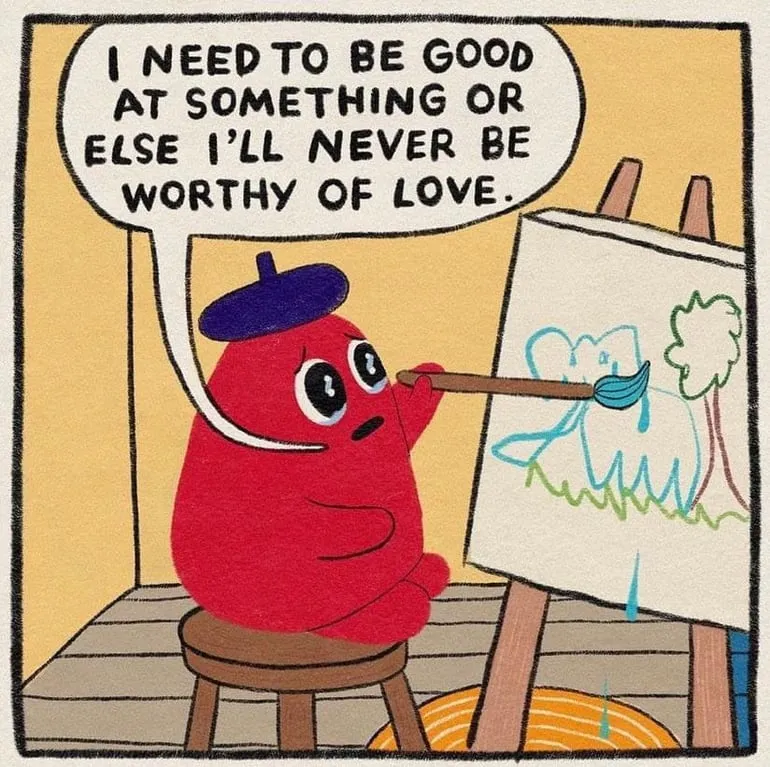 one of my good friends' actual discord pfp. slay bestie & thx for proving my point
I already know how to be a shiny, happy, useful person, and that doing so attracts people to your side. The question I remain uncertain of, through everything, is: how do you get something that endures, even when the mutually beneficial frame breaks down?
—
This is a new social technology I unlocked since writing the OP.↩